
Beginners reach for flashy transitions to make a film exciting; professionals know the opposite is true. The smartest transitions in wedding video editing are nearly invisible — they move the viewer through the story without ever announcing themselves. Used badly, a transition dates a film instantly; used well, you barely notice it. Here is how to use them properly.
The best transition is usually a cut
The straight cut is your default and the most cinematic choice you can make. The vast majority of a wedding film should be clean cuts landing on motion or musical beats. Every other transition is an exception you reach for with a reason — if you cannot name why a shot needs a dissolve or a whip pan, it almost certainly needs a cut.
The cross-dissolve and the passage of time
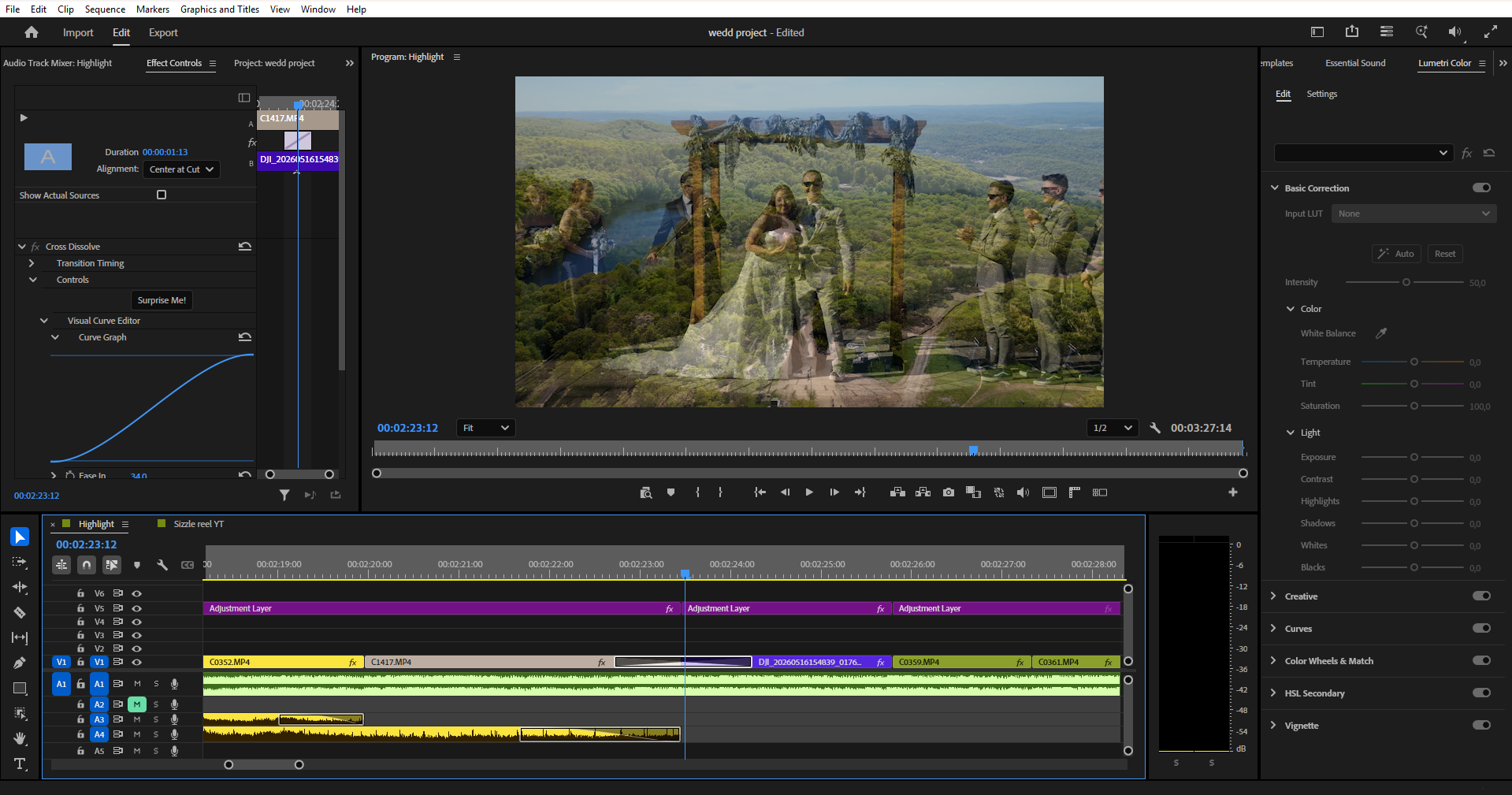
A cross-dissolve signals time passing or a shift in mood or location — which makes it perfect between major sections, like moving from getting-ready into the ceremony, or inside a dreamy montage. What it is not is glue for every clip. Scattering dissolves throughout an edit makes it feel soft and amateurish; save them for where the story genuinely shifts.
Match cuts and motion
A match cut links two shots that share a shape, a motion, or a framing — a push-in on the ground matched to a rising drone move, or a turn of the head that carries across a cut. They take more thought to plan and execute, but a good match cut is one of the most satisfying transitions in wedding video editing because it feels seamless rather than applied.
Speed ramps and whip pans — use with restraint
Speed ramps and whip pans add energy and work well in the celebration sections — but only when the footage motivates them. A whip pan that matches the direction of movement sells; one bolted on between static shots screams effect. Overusing these is the single fastest way to date a wedding film, so reach for them sparingly and let the footage justify each one.
Audio transitions: J-cuts and L-cuts
The transitions viewers feel most are often the ones they cannot see. A J-cut brings the next scene’s audio in before its picture; an L-cut lets the current audio trail under the next shot. Both smooth the join so cuts do not feel abrupt. Crossfade your audio at every cut so levels do not pop — clean audio transitions matter more than any visual effect.
Avoid the plugin-pack trap
Transition packs full of glitches, light leaks, and spins look impressive in a demo reel and cheap in a real wedding film. Restraint reads as taste. The couple wants to remember their day, not admire your transition library — so let pacing and motivated cuts carry the flow, and keep the effects in the drawer.
When to outsource the edit
Knowing which transition to use — and, more often, which to leave out — is an editorial instinct, and it works hand in hand with pacing in wedding video editing. When your season is full, an outside edit team keeps that judgement consistent across every film instead of letting tired choices slip in.
Love Story Editing edits with that restraint as standard through our wedding video editing service. Choose a teaser edit, a ceremony edit, or a full wedding film, see the work on our video portfolio, or request a quote.
The takeaway
The best transitions in wedding video editing are the ones nobody notices: clean cuts as your default, dissolves to mark time, match cuts for seamless motion, J- and L-cuts to smooth the audio, and flashy effects kept firmly in check. Restraint is the whole skill — let the story flow and the transitions disappear, which is exactly what a couple wants from their film.